Search.........

Custom Search
Tampilkan postingan dengan label Russia Aircraft. Tampilkan semua postingan

Mi-24PN Transport-Combat Helicopter

Mi-24PN Transport-Combat Helicopter
The Russian military has selected the upgraded Mi-24PN to be their primary combat helicopter. The PN version has a Tv plus a FLIR camera discovered in a dome on the front of the aircraft. Other modifications consist of employing the rotor blades and wings from the Mi-28 and fixed As opposed to retractable landing gear. The Russians received 14 Mi-24PNs in 2004 and program on Eventually upgrading all of their Mi-24s.

Mi-24PN upgraded transport-combat helicopters intended for accomplishing of night missions began to come} on inventory of Russian Air Force, informed "Interfax - AVN" General Lieutenant Alexander Zelin, Aviation Chief, Deputy Air Force Commander.

The test batch of five Mi-24PN assault helicopters modernized by Rostvertol in Rostov-on-Don was tested |in the 344th Army Aviation Pilot Training Center in Torzhok. The first military unit to receive production versions of the improved Mi-24PN in 2005 was the 487th Separate Helicopter Regiment in Budyonovsk near Chechnya.

Continue Reading of Mi-24PN Transport-Combat Helicopter...

Su-35BM Air Superiority Fighter

Su-35BM Air Superiority Fighter
The Su-35BM (bolshaya modernizatsiya -big modernisation) is a new version of the Sukhoi Su-35 a complicated capability multirole air superiority fighter developed from the Su-27.

The aircraft has high manoeuvrability (+9g) with a high angle of attack and equipped with high-capability weapon systems that contribute to the new aircraft's exceptional dogfighting capability. the most level speed is a pair of,390km/h or Mach 2.25.

The Su-35 is a 4++ generation aircraft using technologies of the fifth generation. Sukhoi claims the aircraft is superior to any other 4th generation fighters now under development worldwide.

Continue Reading of Su-35BM Air Superiority Fighter...

MiG-1.44 Flatpack Multirole Front-Line Fighter

MiG-1.44 Flatpack Multirole Front-Line Fighter
The MiG-1.42/1.44 MFI (Mnogofounksionalni Frontovoi Istrebitel or Multirole Front-Line Fighter) NATO codename Flatpack is an advanced development from the Mikoyan-Gurevich aircraft design bureau initially designed to be a 5th-generation fighter to compete with the US F-22 Raptor and also Sukhoi Su-47 Berkut. Mikoyan boasted that the aircraft was able to outperform its US counterpart with advanced stealth, speed approaching 2500 km/h, and superb manoeuvrability spectrum, but none of this can be substantiated.

Unfortunately this aircraft met an untimely demise thanks to the poor allocation of funding from the Russian Defense Ministry and lack of publicity till late in the 1997, and by then the aircraft was pretty much as good as scrapped. It managed one short test flight in 2000 and was severely hampered by the rarity of the proposed AL-41F engine, developed specifically for the fighter. With the delivery of the engine delayed indefinitely and the mounting expense prices involved with the project, the MiG-MAPO design bureau and the Russian Air Force killed the project in 2001, paving method for the new 5th-generation Russian air superiority fighter to be solely developed by Sukhoi.

Continue Reading of MiG-1.44 Flatpack Multirole Front-Line Fighter...

Su-30 Interceptor Fighter Aircraft

Su-30 Interceptor Fighter Aircraft
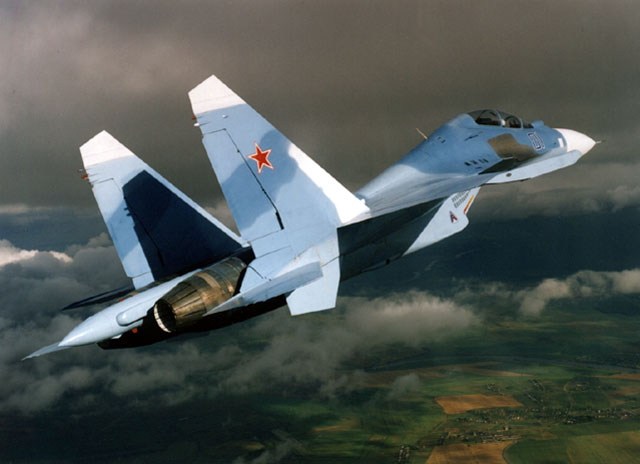
Su-30 (Su-27P) is a two-seat long-range intercept fighter that first flew in December 1989, and entered service with the Russian air forces in 1992. The Su-30 created in Irkutsk. Largely based mostly on the Su-27UB two-seat trainer, it's a new radiolocation system which can transmit the positions of 10 targets to four different fighters at the same time. The the so-called Su-30 series of aircraft began with the Su-27M - in effect a concept demonstrator renamed the Su-35 - the Flanker has evolved into the Su-30 multirole fighter, the Su-32 and Su-34 tactical bomber, and also the Su-33 naval variant. The leading visual difference between the Su-30K and the Su-30MK are canards just under & slightly behind the rear cockpit, TVC nozzles and a twin wheel nose landing gear.

The Su-30 compares favorably with Su-27UB in respect to the distribution of functions between the crewmen. the main distinction is that the workstations in the Su-30 are more similar to each other that clearly distinguishes this fighter from typical two-seat trainers. currently the rear-seat pilot/operator is able in a position is ready to quickly input the coordinates of the new navigation points into the navigation system and airborne weapons system that's used to intercept targets in a long-range rocket engagement.

Continue Reading of Su-30 Interceptor Fighter Aircraft...

Su-33 Flanker-D Naval Fighter Aircraft

Su-33 Flanker-D Naval Fighter Aircraft
The Sukhoi Su-33 (NATO reporting name: Flanker-D) is an all-weather carrier-based air defence fighter designed by Sukhoi and manufactured by KnAAPO. it's a derivative of the Su-27 "Flanker" and was initially called the Su-27K.

Su-33 first flew is in may 1985, and entered service in the Russian Navy in 1994. The air regiment comprising 24 fighters of the type was formed} up on Russia's only operating aircraft carrier, the Admiral Kuznetsov.

The Su-33 can carry guided missiles like the H-25MP. The Su-33 is employed in each night and day operations at sea, and operate with the command center ship and with the Ka-31 early-warning helicopter. With the R-27EM missiles it will intercept antiship missiles. The air-to-ground capability seems to be equivalent to the Su-27SK. it's reported to carry the Kh-31 (AS-17 `Krypton') ASMs underwing. though it had been exhibited with an inert 4,500 kg Kh-41 (3M80 Moskit: mosquito) anti-ship missile on the centerline, this considered as impracticable as an operational load.

Continue Reading of Su-33 Flanker-D Naval Fighter Aircraft...

Su-34 Fullback Fighter-Bomber Aircraft

Su-34 Fullback Fighter-Bomber Aircraft
Designed by the Sukhoi design Bureau, the Su-34 will exchange the Su-24 Fencer frontline bombers. Sukhoi says the new bomber has the potential to become the best and effective plane in its category for years to come. In Russia one Su-34 prices regarding one billion rubles. The $36 million Su-34 fighter-bomber is a two-seat strike aircraft equipped with twin AL-31MF afterburning turbojet engines. it's designed to deliver high-precision strikes on heavily defended targets in all weather conditions, day or night, and fields weaponry that includes a 30mm GSh-301 cannon, up to 12 Alamo or Archer AAMs, ASMs, and bombs.

The Su-34 will be one of the three high performance aircraft that are planned to create the core of the future Russian Air Force, together with the Yak-130 advanced trainer and a new multi-functional fighter (PAK-FA). The Strike Flanker was in competition with the Su-30 to replace the Su-24 and was successful because of the potential of growth of the avionics, since it had twice the space in relation to the opposite airplanes of the Flanker family.

Continue Reading of Su-34 Fullback Fighter-Bomber Aircraft...

Tu-22 Blinder First Soviet Supersonic Bomber

Tu-22 Blinder First Soviet Supersonic Bomber
The Tu-22 Blinder was the first Soviet supersonic bomber design meant to exchange the Tu-16. The Tu-22 original design was aimed at making a bomber that might avoid modern fighter interceptors utilizing its high speed and altitude. The medium range Tu-22 would strike Anglo-American bomber bases and different NATO key targets as well as US Navy Carriers in Europe and Asia.

The Tu-22 design feautres an extended, slender, tube-like fuselage with a sharp pointing nose and swept-back wings. The aircraft was nicknamed 'Shilo' (awl) by its aircrew for its metallic, pointed shape. the two Dobrinin VD-7M engines are located in pods on top of the most body, one at either aspect of the tailplane. From 1965 onwards these were replaced by the improved Kolesov RD-7M2 engine. The layout improved the airflow into the engines, whereas minimizing the possibility of debris sucked up from the ground. draw back of the design was the troublesome maintenance of the engines at this positions, the specified reinforcement of the tail section and also the forward section had to be longered as a result of the middle of gravity was at the rear of the aircraft. the main landing gear is retracted into seperate nacelles extended beyond the wing.

Continue Reading of Tu-22 Blinder First Soviet Supersonic Bomber...

MiG-33 Fulcrum Fighter Aircraft

MiG-33 Fulcrum Fighter Aircraft
The MiG-33 fulcrum is a modernization of the MiG-29, with improvements in several areas. One of the objectives of the modernization was the addition of multifunctionality with further growth of air-air capabilities and air-ground precision weapons. He presented a significant growth in close combat due to increased internal fuel capacity, along with the best pilot in the aircraft cockpit interface and the introduction of new generation equipment.

External changes between the MiG-33 and MiG-29 are negligible. The MiG-33 has changes in the geometry of the shots "including the elimination of the intake shutters, expanding the dimensions of entry for increased air flow, installation of wireless networks to protect engines from the ingestion of objects strangers during takeoff and landing. The number of hard points increased to nine and this allows it to be a suspension of 4.5 tons of payload of bombs or eight [Vympel] RVV-AE air-to-air missiles, the Russian equivalent of the AMRAAM. The MiG-33 can carry the same types of missiles like the MiG-29 did not, and many more. For example, four air-to-surface missiles such as laser-guided Kh-25ML and Kh-29L, guided missiles or TV Kh-29T or four KAB-500KR guided bombs can be.

Continue Reading of MiG-33 Fulcrum Fighter Aircraft...

MiG-27 Flogger Soviet Tactical Air Force

MiG-27 Flogger Soviet Tactical Air ForceMiG-27 Flogger Soviet Tactical Air Force

The MiG-27 Flogger D / J production was completed in mid 1980. They are flown by the former Soviet tactical air force and naval aviation. The MiG-27 Flogger M, named Bahadur (Valiant) is built in India and is being manufactured today. The wings are high-mounted, variable, swept back and tapered with blunt tips. Not a motor inside the body and rectangular box-shaped air intakes in front of the wing roots. There is a single exhaust. The fuselage is long and tubular, unless the air intakes give a box-like appearance. The aircraft has a long, sloping down, pointed nose and a stepped roof. There is a large flap of belly, back, and tapered at the rear. The tail is swept back and tapered tail fin with curved dorsal in the tip and tip angle. Floors swept and tapered high-mounted on the fuselage with angular tips.

The MiG-27 shares the basic structure of the MiG-23, but with revised nose (hereinafter "Utkonos" platypus, in Russian service) presented in the MiG-23B, which suppresses the radar for a declining profile driver that improves visibility and has a laser rangefinder and marked target seeker. Additional cabin armor is installed, along with a completely new navigation-attack. Since the MiG-27 is designed to fly most of their missions at low altitude fighter variables ramps intake and exhaust nozzles have been removed in favor of simpler, fixed configuration, reducing the weight and the need of maintenance. The aircraft also has larger, heavier landing gear for easy operation of aerodromes poor.

Continue Reading of MiG-27 Flogger Soviet Tactical Air Force...

MiG-25 Foxbat Interceptor Aircraft

MiG-25 Foxbat Interceptor AircraftMiG-25 Foxbat Interceptor AircraftMiG-25 Foxbat Interceptor Aircraft Photos

The MiG-25 Foxbat is a high altitude interceptor aircraft. There are several versions of this aircraft: A - basic interceptor; B - recognition, C - Two-seat trainer; D - reconnaissance with a modified radar and E. The Foxbat A aircraft, originally designed to address high-altitude threats, has become Foxbat E, providing a limited number of low-altitude look down and demolition of the capabilities of something comparable to the MiG-23 Flogger. The wings are mounted high, swept back and tapered with square tips. The aircraft has two turbojet engines and large rectangular air intakes below the deck and in front of the wing roots. There are dual exhaust. The fuselage is long and thin, solid nose, he said. The plane is like a box of air intakes to rear section. It has a bubble canopy. In the twin sweptback tail and fins angular with sharp points. Floors are medium to low mounted in the fuselage, swept, and of sharp angular.

The MiG-25 was capable of exceptional performance, including a maximum speed of Mach 3.0 and 90,000 feet ceiling (27,000 m), although a specially modified MIG-25 in 1977 flew to an altitude of 123,524 feet (37,650 m ) in 1977. Some believed that the MiG-25 was designed against the SR-71 Blackbird, made to prevent, or at least threaten the high, high-speed aircraft. However, its maneuverability, range and potential of combat were extremely limited. Even their speed was a problem: although the available thrust was sufficient to reach Mach 3.2, a Mach 2.83 limit had to be imposed to prevent the destruction of the engines (at these speeds the engine started to behave like a ramjet). Even Mach 2.83 was difficult to reach without overspeeding the turbines. The maneuverability of the Mig-25 (maximum acceleration, g load rating was only 2.2 g, with full fuel tanks, with an absolute limit of 4. 5 g) has often been exaggerated by observers Westerners, as under the same performance parameters, the SR-71 is even more restrictive stress limitations.

The maximum speed ever observed by a MiG-25 was Mach 3.2 recorded by a U.S. radar during a flight over Israel in 1973. The Soviet pilot was conducting a reconnaissance mission over the nation when Israel was threatened by surface-to-air missiles. The pilot was in full afterburner and pushed the MiG-25 as fast as he could to return to the safety of an Egyptian airfield. Although the MiG-25 survived the flight, the engines were completely destroyed and had to be replaced.

Continue Reading of MiG-25 Foxbat Interceptor Aircraft...

MiG-29 Fulcrum Air Superiority Fighter

MiG-29 Fulcrum Air Superiority FighterMiG-29 Fulcrum Air Superiority FighterMiG-29 Fulcrum Air Superiority Fighter photos

The MiG-29 Fulcrum is mid-sized air superiority fighter. Fighter aircraft is impressive, with good performance, armament and maneuverability and the ability to use rough airfields. The range is a weak point, and later versions were modified to carry more fuel. A naval version has also been flown. The Russian Air Force seems to prefer the larger Su-27 and its derivatives, but the development of the advanced MiG-29M version has been recently funded. More than 2,000 have been built.

The MIG29 is one of the first Russian aircraft that was considered by many to be equal with the West. He joined a number of innovative technologies, some of whom had never been seen in any Western fighter. It also reflects a change in Russian aerial tactics. For example, before there was a strong dependence on the control and guidance of the earth, therefore, had little need for a cabin with a great view, and since it was easier to make them smaller for aerodynamic reasons, as was the trend of Mig-21, MiG-23 and Mig-25. However, the Mig 29 has been designed with a large bubbles cover similar to those of most western fighters suggesting a change of tactics.

Lamas doors close the engine intake, while in the field compressor protection against foreign object damage (FOD). Air is drawn through a series of slots in the top of the wing root. In Mig29M (a further development) these doors have been replaced by a mesh grille similar to that of the Su27. It reduces complexity and created extra space for the fuel and avionics by removing the jacks at the top of the wing root.

Continue Reading of MiG-29 Fulcrum Air Superiority Fighter...

Su-27 Superiority Fighter Aircraft

Su-27 Superiority Fighter AircraftSu-27 Superiority Fighter AircraftSu-27 Superiority Fighter Aircraft Photos

The Su-27 is a long range superiority fighter aircraft, comparable to the U.S. F-15, but superior in many respects. It is a twin-engine airplane with one wing and fuselage combination and double tail fins. At airshows the Su-27 has demonstrated a capacity for exceptional control at high angles of attack.

The huge Su27 airframe is constructed from advanced lightweight aluminum alloys and lithium, making it light for its size. The wing is designed with a pointed shape and extent wingroot. The wing has a sweep of 42 degrees main advantage of full span slats and trailing edge flaperons edge. The flaperons combine the functions of conventional flaps and ailerons and move in unison, bands to provide the lift and drag. They move in unison to function as ailerons.

The engines of the Su-27 are two turbofan engines designed by AM Lyul'la AL31F, the MMZ Saturn General Designer. These engines are considered very economical and has a capacity of 12,500 kg of static thrust in afterburner and 7600 kg in military power. The engine has proven reliable AL31F, robust and easy to maintain. When tested in severely disturbed airflow, and in extreme conditions, the engine performed effectively. That is why maneuvers like the tail slide and Cobra are possible.

Continue Reading of Su-27 Superiority Fighter Aircraft...

MiG-31 Foxhound Long-range Interceptor Fighter

MiG-31 Foxhound Long-range Interceptor FighterMiG-31 Foxhound Long-range Interceptor FighterMiG-31 Foxhound Long-range Interceptor Fighter Photos

The MiG-31 long-range interceptor was developed from the MiG-25. The two-seater MiG-31 fighter has more capable equipment, including the powerful "Zaslon" phased array radar with a range of 200 km. It states that a MiG-31 unit can link their radars together, to establish a search pattern - covering a width of 800 to 900 km with four aircraft, spaced at 200 km.

The MiG-31 Foxhound interceptor was the most advanced in the field by the Soviet Union before its dissolution. About 500 MiG-31 were produced. It is still unclear when Russian Air Force MiG-31 will eliminate, but according to their importance and no clear successor in the line, is likely to continue to serve for as long as 2015.

Continue Reading of MiG-31 Foxhound Long-range Interceptor Fighter...

Sukhoi Su-37 Terminator Multi-role fighter

Sukhoi Su-37 Terminator Multi-role fighterSukhoi Su-37 Terminator Multi-role fighterSukhoi Su-37 Terminator Multi-role fighter Photos

Multi-role fighter Su-27 version, developed from the Su-35. The sukhoi Su-37 Terminator uses full digital FBW controls in combination with two-dimensional thrust vectoring nozzles as the Su-35, have been hoaxes. However, Su-35 continued development and modern Su-35 are much more advanced than the Su-37 prototype that flew in 1990, some of the technology being incorporated into the Su-35BM.

The Su-37 did not reach the production stage, but in mid-2000 made several upgrades Sukhoi Su-27, and Su-30MKI Su-35/Su-35BM generation, and second, that have similar improvements, such as improved avionics and radar systems and thrust vectoring engines.

Continue Reading of Sukhoi Su-37 Terminator Multi-role fighter...

Su-35 Super Flanker Fighter Aircraft

Sukhoi Su-35 Super Flanker Fighter AircraftSukhoi Su-35 Super Flanker Fighter AircraftSukhoi Su-35 Super Flanker Fighter Aircraft Photos

Sukhoi Su-35 Super Flanker is a improved version of the Su-27, with canard foreplanes, the most powerful radar, more powerful engines, and possibly thrust vectoring nozzles, and an upgrade of electronics.

It also has a new N-011 radar with a range of 400 kilometers (or 200 km against ground targets), which can simultaneously track more than 15 targets, with the participation of six. The resort offers new support for advanced EO "smart" weapons. Advanced data binding allows coordinated operation of groups and tail cone houses the antenna of a rear-facing radar, allowing you to "over-the-shoulder" shots fired missiles.

The Su-35 is compatible with the new 400 km Novator KS-172 AAM-L missile. Flight testing on the production of reports, now complete and has been funded. The Su-35 is very similar to the Su-33. That are expected to upgrade Su-35 with thrust vector control as seen in the Su-37.

Continue Reading of Su-35 Super Flanker Fighter Aircraft...

Yak-141 Freestyle Supersonic VTOL Fighter

Yak-141 Freestyle Supersonic VTOL FighterYak-141 Freestyle Supersonic VTOL FighterYak-141 Freestyle Supersonic VTOL Fighter Photos

The Yak-141 Freestyle is the first supersonic VTOL fighter in the world. Works with lift engines in the fuselage and a nozzle of vectors in the main engine, placed well forward, between the tail booms individual. The Yak-141 seems to be more a technology demonstrator of a real fighter, and the need to use afterburner for take-off is a different problem. Development is ongoing, having been temporarily suspended.

Continue Reading of Yak-141 Freestyle Supersonic VTOL Fighter...

MiG-35 Fulcrum Fighter Aircraft

MiG-35 Fulcrum Fighter AircraftMiG-35 Fulcrum Fighter AircraftMiG-35 Fulcrum Fighter Aircraft Photos

The MiG-35 Fulcrum is classified as a 4 + + generation fighter aircraft and, now classified as a medium-weight aircraft because its maximum takeoff weight increased by 30 percent.The battle has much improved avionics and weapons systems , in particular the new AESA radar and optical system design exclusive Locator (OLS), eases the aircraft to rely on a ground-controlled interception (GCI) systems and allows you to conduct independent multi-function missions. A prototype made its first flight in February 1997, the final design was first introduced uring the Aero India 2007 air show.

Continue Reading of MiG-35 Fulcrum Fighter Aircraft...

Sukhoi Su-47 Berkut High Manoeuvrability Aircraft

Sukhoi Su-47 Berkut High Manoeuvrability AircraftSukhoi Su-47 Berkut High Manoeuvrability AircraftSukhoi Su-47 Berkut High Manoeuvrability AircraftSukhoi Su-47 Berkut High Manoeuvrability Aircraft Photos

Highly Manoeuvrability and high angle of attack, the Su-47 Berkut (Eagle), initially known as the S-37, using a wing configuration to the sweep. The Su-47 completed the first stage of flight tests in December 2001.

Although the Russian aircraft was built as a testbed for the development of the fifth generation of technologies in May 2002, Sukhoi was selected as prime contractor for the agenda of the next generation Russian PAK FA fighter. Although the Su-47 is used for the PAK FA program, the design will probably be very different.

The Su-47 has extremely high agility at subsonic speeds, enabling the aircraft to alter its angle of attack and its flight path very quickly. It also retains its great maneuverability in supersonic flight.

Continue Reading of Sukhoi Su-47 Berkut High Manoeuvrability Aircraft...

Su-25 Frogfoot Anti-Tank Aircraft

Su-25 Frogfoot Anti-Tank AircraftSu-25 Frogfoot Anti-Tank AircraftSu-25 Frogfoot Anti-Tank Aircraft photos

Heavy armor and attack anti-tank aircraft. The Su-25 is a well-armed aircraft, capable of carrying a heavy load on his shoulders, put the wings. Compared with its U.S. counterpart, the A-10, is faster and more agile. The Su-25 saw combat in Afghanistan, and the experience led to major improvements. A naval version was built for the large carriers. Later models have more powerful R-195 engines.

The Su-25, which is no longer in series production, made its first flight in 1979. This single seat ground attack aircraft is a very durable airplane - it is quite heavily armed - and easy maintenance - service equipment can be stored in a container and transported by the aircraft itself. He is armed with a double barrel gun of 30 mm at the bottom of the fuselage with 250 rounds. There are 8 pylons under the wings, which can lead to about 4. 000 kg of air-ground weapons, including 57 mm to 330 mm rockets. There are two small towers outboard or AA-8/APHID AA-2D/ATOLL MEAs.

The wings are high-mounted and cone-shaped end with straight edges. There are pods mounted at the ends square. There are two turbojets mounted alongside the body under the wings. There are vents half point ahead of the leading wing edges. There tailpipes at the rear edge of the wings "at the end. The fuselage is long and thin and has a rounded nose. The body tapers to the rear that overhangs the exhausts. There is a stepped canopy . The tail is swept back and fin is tapered with a square toe. The floor-mounted mid-fuselage, unequally tapered with blunt tips.

Continue Reading of Su-25 Frogfoot Anti-Tank Aircraft...

SU-24M Fencer Strike Attack Aircraft

SU-24M Fencer Strike Attack AircraftSU-24M Fencer Strike Attack AircraftSU-24M Fencer Strike Attack Aircraft photos

The Su-24M is manufactured by the company Sukhoi Design Bureau Joint Stock, based in Moscow, Novosibirsk and Aircraft Production Association, Novosibirsk, Russia. The Su-24M entered service in 1983 and is a development of the Su-24, known as "Fencer" the NATO codename.

The SU-24M Fencer Strike Attack Aircraft is designed to penetrate enemy territory and destroy ground targets and the surface in any weather, day and night. The Su-24 variants have also been designed for reconnaissance and electronic measures.

400 Russian Air Force Su-24M are updated with the M2 standard navigation and weapons systems to allow the release of new versions of the Kh-29 and other projectiles. Improvements include a new SV-24 computer, liquid crystal displays, ILS-31 Head-Up Display, Digital motion map and global positioning system. The Su-24 will be replaced in the Russian service of the Air Force Su-35, from 2010.

Continue Reading of SU-24M Fencer Strike Attack Aircraft...